High Frequency Screen
高频筛
议价
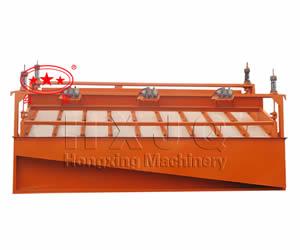
加入意向高频筛采用尼龙或不锈钢板,是重要的矿物质颗粒选设备。
高频矿筛具有效率高,振幅小,筛分频率高的功能。
从筛分设备的一般原则不同的是,高频矿物屏幕方面采用了高频率; 一方面,它可以破坏纸浆和优良材料高速的表面张力。
振荡的筛面。 另一方面,高频矿物屏幕可以加速大密度有益矿物质和分析,增加的分离粒状物概率。
联系与筛孔。 因此,产生更好的条件,也可以使分离颗粒物料尤其是大比例的材料和纸浆是筛产品通过筛孔。
矿高频筛物理原理
振动 - 无论是正弦振动或回转震动。
正弦振动发生在成角度的平面相对于水平的。 振动是由频率和幅度所决定的波形。
旋回振动发生在靠近水平面在低角度往复一边到另一边的运动。
重力 - 此物理相互作用是后材料从使其下降到一个较低的水平屏幕抛出。 重力也拉通过筛网的颗粒。
密度 - 该材料的密度涉及材料分层。
静电力 - 这股力量适用于筛查时,颗粒非常干燥或潮湿。
矿高频筛筛选术语
如同任何机械和物理实体有科学,工业和外行的术语。 以下是与机械筛分相关术语的部分列表。
幅度 - 这是筛布,因为它垂直峰到其最高高度和波谷的最低点的测量。 测量加速度常数G(重力加速度)的倍数。
加速 - 应用加速的筛网,以克服范德华力
致盲 - 当材料插入筛布的开口槽,并且抑制溢流材料免于落下穿过。
涂刷 - 这个程序是通过谁使用刷子刷满屏幕布脱落失明开放操作员执行。
布,筛选布 - 它是通过网眼尺寸限定的材料,它可以由任何类型的材料,例如钢,不锈钢,橡胶化合物,黄铜等的
污染 - 这是在一个给定的级不需要的材料。 发生这种情况时,有大小材料相对于切割或超大级或罚款。 另一种类型的污染的是异物污染。
当在高频矿石screensuch该孔比所述屏幕的筛目尺寸较大的孔发生过大的污染。 其中,超大发生其他情况的材料溢出落入年级的开销,或者有错误的网眼尺寸屏幕的地方。
罚款污染时筛布大的部分被蒙蔽了,和物质流过屏幕不会落空。 罚款,然后保持在年级。
异物污染是不同于原始材料一遍又一通过屏幕不需要的材料。 它可以是任何东西,从树的树枝,草,以及其他矿物种类和成分的金属渣。 当在粗粒筛孔或异物的矿物学或化学成分不同于原始材料会发生这种污染。
甲板 - 甲板的框架或设备,其持有筛布到位。 它也包含了筛选驱动器。 它可以包含多个节作为材料从进料端向排出端移动。 多甲板屏幕甲板放置在配置中有一系列垂直和精益连接在相同的角度,因为它出发,超越甲板甲板。
多个甲板通常被称为单甲板,双层,三层甲板等
频率 - 测量以赫兹(Hz)或每分钟转数(RPM)。 频率是时间在一秒钟内筛布正弦盟友的波峰和波谷的数量。 作为用于回转筛选运动它是筛网或筛板取入一个时间间隔,如每分(RPM)旋转的转数。
分等,分级 - 也称为切或切割。 定在初始状态的进料材料,该材料可以被定义为具有的粒度分布。 分级是由网状的选择方式去除的最大尺寸的材料和最小尺寸的材料。
振动筛 - 一个通用术语,是指任何类型的机械筛分机整机装配。
分层 - ,会出现此现象为振动通过一个床材料通过。 这会导致粗(大)料上涨,更细(小)材料床内下降。 与筛布接触的材料既可以通过一个槽跌倒或百叶窗的槽或触点的布材料,并从布抛出下降到下一个较低的水平。
目 - 网格是指每线性英寸开放的时隙的数目。 目被安排在多个配置。 目可以是一个方形图案,长开槽矩形图案,圆形图案,或菱形图案。
头皮,倒卖 - 这是来料其所有成绩的总和的第一晋级。 倒票指除去最大尺寸的颗粒。 这包括相对于其它粒子的大小极大地大的颗粒。 倒票也清除从异物污染进入的材料如嫩枝,垃圾,玻璃,或其它不想要的大尺寸材料。
高频筛技术参数
| 模型 | 屏幕平方(米2) | 输入材料的厚度(%) | 生产能力(T / H) | 功率(kw) |
| GPS-4 | 4.5 | 30%-40% | 15-25 | 0.72 |
| GPS-5 | 5.2 | 30%-40% | 20-30 | 1.1 |
| GPS-6 | 6 | 30%-40% | 24-36 | 1.5 |
| GPS-8 | 8.1 | 30%-40% | 32-48 | 2.2 |
High frequency screen used nylon or stainless steel plate, is essential mineral granular election equipment.
High frequency mineral screen has the feature of high efficiency, small amplitude, and high frequency of screening.
Different from the general principle of sieving equipments, high frequency mineral screen uses high frequency; on the one hand, it can destroy the surface tension of pulp and fine materials high-speed.
Oscillating on the sieve surface. On the other hand, the high frequency mineral screen can accelerate large density useful minerals and analysis, increase probability of the separation granular materials.
Contacting with the sieve hole. Thus result in better conditions, and can make the separation granular materials especially the large proportion of the materials and the pulp to be sieve products through sieve hole.
Mineral high frequency screen Physical principles
Vibration - either sinusoidal vibration or gyratory vibration.
Sinusoidal Vibration occurs at an angled plane relative to the horizontal. The vibration is in a wave pattern determined by frequency and amplitude.
Gyratory Vibration occurs at near level plane at low angles in a reciprocating side to side motion.
Gravity - This physical interaction is after material is thrown from the screen causing it to fall to a lower level. Gravity also pulls the particles through the screen cloth.
Density - The density of the material relates to material stratification.
Electrostatic Force - This force applies to screening when particles are extremely dry or is wet.
Mineral high frequency screen Screening terminology
Like any mechanical and physical entity there are scientific, industrial, and layman terminology. The following is a partial list of terms that are associated with mechanical screening.
Amplitude - This is a measurement of the screen cloth as it vertically peaks to its tallest height and troughs to its lowest point. Measured in multiples of the acceleration constant g (g-force) .
Acceleration - Applied Acceleration to the screen mesh in order to overcome the van der waal forces
Blinding - When material plugs into the open slots of the screen cloth and inhibits overflowing material from falling through.
Brushing - This procedure is performed by an operator who uses a brush to brush over the screen cloth to dislodged blinded opening.
Cloth, screening cloth - it is the material defined by mesh size, which can be made of any type of material such steel, stainless steel, rubber compounds, brass, etc.
Contamination - This is unwanted material in a given grade. This occurs when there is oversize or fine size material relative to the cut or grade. Another type of contamination is foreign body contamination.
Oversize contamination occurs when there is a hole in the high frequency ore screensuch that the hole is larger than the mesh size of the screen. Other instances where oversize occurs is material overflow falling into the grade from overhead, or there is the wrong mesh size screen in place.
Fines contamination is when large sections of the screen cloth are blinded over, and material flowing over the screen does not fall through. The fines are then retained in the grade.
Foreign body contamination is unwanted material that differs from the virgin material going over and through the screen. It can be anything ranging from tree twigs, grass, and metal slag to other mineral types and composition. This contamination occurs when there is a hole in the scalping screen or a foreign material's mineralogy or chemical composition differs from the virgin material.
Deck - a deck is frame or apparatus that holds the screen cloth in place. It also contains the screening drive. It can contain multiple sections as the material travels from the feed end to the discharge end. Multiple decks are screen decks placed in a configuration where there are a series of decks attached vertically and lean at the same angle as it proceeding and exceeding decks.
Multiple decks are often referred to as single deck, double deck, triple deck, etc.
Frequency - Measured in hertz (Hz) or revolutions per minute (RPM) . Frequency is the number of times the screen cloth sinusoid ally peaks and troughs within a second. As for a gyratory screening motion it is the number of revolutions the screens or screen deck takes in a time interval, such as revolution per minute (RPM) .
Gradation, grading - Also called cut or cutting. Given a feed material in an initial state, the material can be defined to a have a particle size distribution. Grading is removing the maximum size material and minimum size material by way of mesh selection.
Shaker - A generic term that refers to the whole assembly of any type mechanical screening machine.
Stratification - This phenomenon occurs as vibration is passed through a bed of material. This causes coarse (larger) material to rise and finer (smaller) material to descend within the bed. The material in contact with screen cloth either falls through a slot or blinds the slot or contacts the cloth material and is thrown from the cloth to fall to the next lower level.
Mesh - Mesh refers to the number of open slots per linear inch. Mesh is arranged in multiple configurations. Mesh can be a square pattern, long-slotted rectangular pattern, circular pattern, or diamond pattern.
Scalp, scalping - this is the very first cut of the incoming material with the sum of all its grades. Scalping refers to removing the largest size particles. This includes enormously large particles relative to the other particle's sizes. Scalping also cleans the incoming material from foreign body contamination such as twigs, trash, glass, or other unwanted oversize material.
Technical parameters of High frequency screen
| Model | Screen square (m2) | Thickness of input material (%) | Capacity (t/ h) | Power (kw) |
| GPS-4 | 4.5 | 30%-40% | 15-25 | 0.72 |
| GPS-5 | 5.2 | 30%-40% | 20-30 | 1.1 |
| GPS-6 | 6 | 30%-40% | 24-36 | 1.5 |
| GPS-8 | 8.1 | 30%-40% | 32-48 | 2.2 |

&img=www.atupapa.com/show/wxbuyer/img/apk.png&url=//www.atupapa.com/show/wxbuyer/whatnear.apk)