- Marketplace
- Merchants
- Restaurants
- UAE house
- Cloud accounting (GCC VAT)
- Me
- Cart
- My order
- Address book
- Favorite
- Link
- About us
- Download App
- 中文
- Merchant panel
Top Level Antioxidants Alpha Lipoic Acid
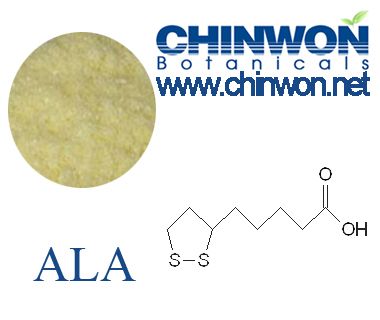
Product Name: Alpha Lipoic Acid
Also known as: Thioctic Acid;
Purity: 99-101%
CAS NO.: 1077-28-7
Molecular formula: C8H14O2S2
Molecular weight: 206.33
Appearance: Yellow crystalline powder,no obvious odor.
Melting point: 60.0-62.0 degree centigrade
Drying loss: Not more than 0.2%
Effects & Applications
1) ALA is a good antioxidant. Taken internally, it is a water and fat soluble antioxidant that is capable of regenerating other antioxidants, such as vitamins C and E;; it also can help prevent cellular damage via its antioxidant properties.
Usually it is used for diabetes, peripheral neuropathy, cardiac autonomic neuropathy, retinopathy, cataracts, and glaucoma. Alpha-lipoic acid is also used orally for dementia, chronic fatigue syndrome , HIV/AIDS, cancer, liver disease, cardiovascular disease, peripheral arterial disease, intermittent claudication, Lyme disease, and lactic acidosis caused by inborn errors of metabolism.
2) It also has anti-inflammatory effects
3) Topically, alpha-lipoic acid is used to reduce facial wrinkles, lines, and sun damage.
but it is extremely vulnerable to degradation by sunlight, and 5% or higher alpha lipoic acid are capable of causing burning or stinging sensations or a mild rash on skin.
Also we supply following ALA products
ALA COA technical DATA
Also known as: Thioctic Acid;
Purity: 99-101%
CAS NO.: 1077-28-7
Molecular formula: C8H14O2S2
Molecular weight: 206.33
Appearance: Yellow crystalline powder,no obvious odor.
Melting point: 60.0-62.0 degree centigrade
Drying loss: Not more than 0.2%
Effects & Applications
1) ALA is a good antioxidant. Taken internally, it is a water and fat soluble antioxidant that is capable of regenerating other antioxidants, such as vitamins C and E;; it also can help prevent cellular damage via its antioxidant properties.
Usually it is used for diabetes, peripheral neuropathy, cardiac autonomic neuropathy, retinopathy, cataracts, and glaucoma. Alpha-lipoic acid is also used orally for dementia, chronic fatigue syndrome , HIV/AIDS, cancer, liver disease, cardiovascular disease, peripheral arterial disease, intermittent claudication, Lyme disease, and lactic acidosis caused by inborn errors of metabolism.
2) It also has anti-inflammatory effects
3) Topically, alpha-lipoic acid is used to reduce facial wrinkles, lines, and sun damage.
but it is extremely vulnerable to degradation by sunlight, and 5% or higher alpha lipoic acid are capable of causing burning or stinging sensations or a mild rash on skin.
Also we supply following ALA products
ALA COA technical DATA
| TEST | RESULTS | ||
| Appearance | Pale yellowish crystalline powder | ||
| Assay | 99.29% | ||
| Melting Point | 60.0~62.0 degree centigrade | ||
| Specific Rotation | -1.00°-+1.00° | ||
| Loss on drying | 0.03% | ||
| Residue on ignition | 0.02% | ||
| Heavy Metals | ≤10ppm | ||
| Limit of polymer content | ﹤2.0% | ||
| Related Substance (HPLC) | |||
| 6.8-Epitrithiotic Acid | 0.02% | ||
| Single unknown impurity | 0.04% | ||
| Total Impurities | 0.08% | ||
| Microbiology & Solvents Residue | |||
| Total Aerobic count | ﹤100CFU/g | ||
| Mold & yeast | ﹤10 CFU/g | ||
| Escherichis coil | None detected | ||
| Salmonellosis | None detected | ||
| Cyclohexane | 600ppm | ||
| Toluene | ≤20ppm | ||
| Ethyl acetate | None detected | ||

&img=www.atupapa.com/show/wxbuyer/img/apk.png&url=//www.atupapa.com/show/wxbuyer/whatnear.apk)